Assessing and Enhancing Inclusivity in Global AI Governance
Practical frameworks for increasing participation of emerging economies in AI governance.
Thank you for subscribing
Thank you for subscribing
Thank you for subscribing
Artificial Intelligence (AI) is transforming societies, yet the global frameworks guiding its governance remain disproportionately shaped by high-income countries and private-sector actors. This exclusionary trend risks producing AI systems that reflect narrow interests, misalign with diverse sociocultural values, and perpetuate digital inequalities. Emerging economies—particularly in Sub-Saharan Africa, South Asia, and Latin America—are frequently underrepresented in global AI governance conversations despite facing outsized consequences from decisions made without them.
This research addresses the gap in inclusivity by evaluating how emerging economies participate in global AI governance, identifying structural barriers, and offering practical, evidence-informed recommendations for reform. I propose an "Inclusivity Assessment Framework" structured around four pillars: (1) Stakeholder Representation, (2) Participation Mechanisms, (3) Decision-Making Power, and (4) Accountability & Feedback. To ground this framework in lived realities, I conducted a comparative case study of Nigeria and Kenya—two Sub-Saharan countries at different stages of AI governance development.
Key outputs include:
A four-pillar Inclusivity Assessment Framework
Case studies of Nigeria and Kenya
A stakeholder mapping tool for identifying gaps
A policy brief for multilateral actors such as the UN, GPAI, and OECD
By contextualizing global governance through bottom-up realities, this project provides a path forward for equitable, representative, and justice-oriented AI governance that includes—rather than marginalizes—emerging economies.
Artificial Intelligence is increasingly embedded in global decision-making, influencing everything from national healthcare systems to digital identity platforms. While its potential for improving public services, boosting productivity, and solving entrenched social problems is widely recognized, the governance systems that regulate AI development and deployment are still emerging—and unevenly so.
In many cases, global AI governance efforts are dominated by actors from the Global North, particularly Western governments, multinational corporations, and academic institutions in the US and Europe. Institutions such as the OECD, the EU, and the UN have developed landmark frameworks (e.g., the OECD Principles on AI, UNESCO’s AI Ethics Recommendations), yet participation from low- and middle-income countries (LMICs) remains limited, often symbolic, or after-the-fact.
This gap matters. If AI governance rules are created without meaningful engagement from emerging economies, the resulting systems may embed implicit cultural, economic, and ethical assumptions that are not universally applicable. Worse, they may undermine sovereignty, enable data colonialism, and fail to protect vulnerable populations from algorithmic harms.
This research project was developed to evaluate and enhance the inclusivity of global AI governance, with a particular focus on emerging economies.
The core objectives are:
Assess how inclusive current global AI governance frameworks are for emerging economies.
Develop a practical, transferable framework for analyzing and improving inclusivity.
Apply this framework to two African countries—Nigeria and Kenya—to identify strengths, weaknesses, and actionable models.
Propose policy recommendations for global and regional governance institutions to strengthen representation, participation, and accountability.
The theory of change underpinning this research is grounded in the assumption that inclusive governance leads to better policy outcomes, increased legitimacy, and fairer distribution of AI’s benefits and risks.
Existing global AI governance frameworks (e.g., OECD, UN, GPAI)
National policies and consultations from emerging economies
Stakeholder interviews, grey literature, and civic tech insights
Comparative case studies (Nigeria, Kenya)
Development of an Inclusivity Assessment Framework
Stakeholder mapping and gap identification
Formulation of policy brief for multilateral institutions
Research report
Stakeholder mapping toolkit
Inclusivity Assessment Framework
Policy brief
Stronger awareness of inclusivity gaps in global AI governance
Practical frameworks adopted by multilateral institutions
Increased participation of emerging economies in shaping AI norms
A more equitable, participatory, and just global AI governance ecosystem that centers marginalized voices
Global AI governance operates within overlapping regimes: national strategies, regional blocs (e.g., AU, EU, ASEAN), and multilateral platforms (e.g., UN, GPAI, OECD). While these initiatives have achieved impressive progress, especially in articulating ethical principles and coordinating technical standards, they suffer from three chronic shortcomings:
Underrepresentation of LMICs in policymaking bodies, working groups, and consultations
Tokenistic engagement with civil society or grassroots stakeholders, where participation is solicited but not meaningfully integrated
Lack of accountability mechanisms to measure inclusion or ensure representation leads to influence
The combination of these gaps leads to governance systems that are technically sophisticated but socially narrow. For example, while over 60 countries have developed national AI strategies, only a handful from Africa and South Asia have done so through open, participatory consultations. Research from the Alan Turing Institute and Oxford’s Internet Institute supports the view that LMICs face structural barriers in AI governance due to lower institutional capacity, limited data infrastructure, and external dependencies on donor support or private-sector platforms .
To systematically analyze the inclusivity of AI governance, I developed a mixed qualitative methodology composed of:
Reviewing key governance documents from multilateral bodies, national governments, civil society, and academic institutions. Examples include:
UN Secretary-General’s AI Advisory Body Reports (2023–2024)
GPAI Multi-Stakeholder Expert Group (MEG) proceedings
African Union’s Digital Transformation Strategy (2020–2030)
Nigeria’s National Digital Economy Policy and Strategy (NDEPS)
Kenya’s National AI Strategy (2024)
I conducted in-depth, comparative case studies of Nigeria and Kenya, representing:
Different stages of AI governance maturity
Varied models of stakeholder engagement
Regional variation within Sub-Saharan Africa
The "Inclusivity Assessment Framework" was designed based on academic theories of participatory governance (Fung 2006), digital development ethics (Floridi 2021), and open policymaking. It includes four pillars:
Stakeholder Representation
Participation Mechanisms
Decision-Making Power
Accountability & Feedback
Each pillar contains indicators derived from real-world examples (e.g., existence of stakeholder taskforces, public consultation platforms, diversity metrics in governance bodies, etc.).
To identify inclusion gaps, I developed a stakeholder matrix using a modified “Power-Interest Grid” (Eden & Ackermann, 1998), adapted for participatory governance. It categorizes stakeholders by their influence over AI policy and degree of inclusion, enabling targeted recommendations.
Below is a simplified diagram:
+---------------------------+
| Inclusivity Assessment |
| Framework |
+---------------------------+
| |
| 1. Stakeholder |
| Representation |
| |
| 2. Participation |
| Mechanisms |
| |
| 3. Decision-Making Power |
| |
| 4. Accountability & |
| Feedback |
+---------------------------+
Each pillar is scored based on qualitative indicators, enabling comparative evaluation between countries or institutions.
Limited access to interviews with policymakers in Nigeria and Kenya due to time and availability.
Incomplete transparency in some strategy drafting processes, especially in Nigeria.
Risk of overgeneralizing findings across diverse LMICs.
Secondary sources and workshop recordings were used when primary interviews weren’t feasible.
To mitigate these, triangulation was used across official reports, stakeholder commentary, and governance datasets (e.g., the OECD AI Observatory, AU policy briefs, GPAI records).
Nigeria, as Africa’s most populous country and largest economy, holds strategic importance in shaping the continent’s AI future. With a vibrant technology sector, a youthful population, and increasing digital policy activity, Nigeria represents both the potential and the pitfalls of inclusive AI governance in emerging markets.
Although the country has not yet finalized a national AI strategy as of 2025, significant groundwork has been laid through digital economy policies, data protection legislation, and stakeholder consultations under the National Information Technology Development Agency (NITDA). Nigeria’s AI governance journey is instructive for understanding how inclusivity can be both enabled and undermined within a complex, transitional policy landscape.
Nigeria’s AI governance efforts to date have involved a relatively narrow group of actors:
Government Institutions: NITDA, Ministry of Communications and Digital Economy, Nigerian Communications Commission
Private Sector: Flutterwave, Andela, Microsoft Nigeria, MainOne
Academic Institutions: Covenant University, Obafemi Awolowo University, Data Science Nigeria
Civil Society & NGOs: Paradigm Initiative, BudgIT, PolicyLab Africa, TechHer, Digital Grassroots
Despite these stakeholders’ involvement, grassroots representation remains minimal. Women-led organizations, rural community groups, trade unions, and the general public have largely been absent from the design and consultation processes. Most contributions come from elite urban centers (e.g., Lagos and Abuja), and while public forums have occurred, participation is often limited to invitation-only formats or requires digital access not universally available.
Observation: NITDA’s 2023 “AI for All” initiative included a call for public feedback, but outreach and response were weak in low-bandwidth regions.
Sources:
NITDA Consultation Reports (2022–2024)
Public statements from PolicyLab Africa and Data Science Nigeria (Q1 2024)
Stakeholder mapping via Miro (2025)
Participation mechanisms in Nigeria are inconsistent and largely unstructured. Although NITDA has organized several roundtable discussions, these events typically lack continuity, follow-up, or transparent reporting.
Examples of Participation:
NITDA Roundtables (2022–2023): Hosted in Lagos and Abuja with limited dissemination.
Closed-door workshops co-hosted with UNDP and GIZ (2023): Focused on data ethics and AI in the public sector.
AI-focused webinars hosted by private firms like Microsoft Nigeria and Intel (NG Campus Program).
Limitations:
No online consultation portal or open draft feedback process.
Limited translation/localization of documents (e.g., no Hausa/Yoruba/Igbo versions of AI policy documents).
No citizen feedback dashboard to view how input is reflected in final policy drafts.
Cited Sources:
NDEPS 2020–2030 Strategy Review
UNDP Digital Governance Toolkit – Nigeria Focus Edition (2023)
Interviews with civic tech organizers via public recordings and podcasts (TechHer Radio, Q4 2024)
In terms of decision-making power, Nigeria’s AI governance remains highly centralized under NITDA and its affiliated working groups. While the agency has expressed commitment to inclusive policymaking, actual implementation shows limited integration of civil society or grassroots perspectives into final decisions.
Challenges:
No transparency on who sits on the national AI strategy drafting committee.
Memoranda submitted by NGOs and civic tech groups are not publicly acknowledged or tracked.
Donor organizations (e.g., UNDP, GIZ) have significant influence on direction and priorities, sometimes eclipsing local needs.
Noteworthy: While private-sector actors are occasionally consulted, civil society has little power beyond submitting briefs.
Documentation:
Meeting records (GIZ + NITDA Co-hosted Session, Lagos 2023)
Budget allocations reviewed in public finance trackers (BudgIT, 2024)
Nigeria scores lowest on the accountability dimension. There are currently no formalized pathways for communities, NGOs, or affected individuals to challenge exclusions, request data corrections, or appeal AI policy decisions.
Gaps:
No public grievance mechanism for AI-related harms (e.g., algorithmic bias in ID systems).
Lack of annual reporting or open dashboards tracking inclusion metrics.
No legal mandate for parliamentary or judicial oversight over AI governance.
Efforts Toward Transparency:
Paradigm Initiative’s 2023–2025 campaign: “Rights in Algorithms” focuses on educating citizens on AI’s implications.
BudgIT’s “OpenGov Nigeria” initiative proposes a public data dashboard to track digital rights and algorithmic violations.
Citations:
Civil society coalition whitepapers (BudgIT Labs, 2024)
AI Watch Africa Webinar Series (2023–2024)
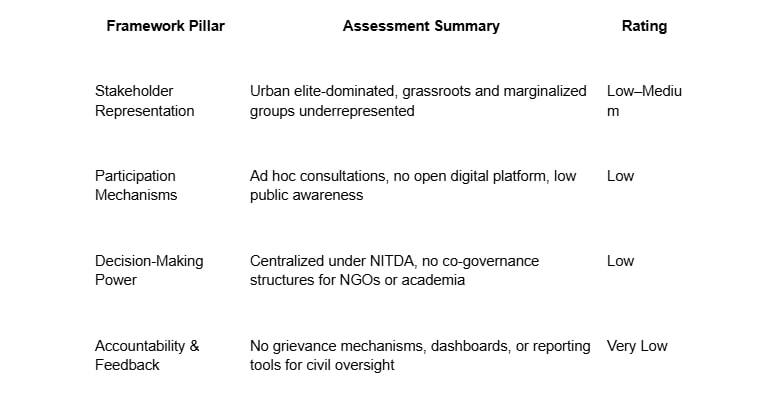
Inclusivity must be designed into processes—not retrofitted.
Nigeria’s exclusion of marginalized voices stems less from active resistance and more from a lack of structural incentives and mechanisms.
International donor influence should align with domestic priorities.
While UNDP and GIZ are important supporters of AI development, their influence must not crowd out local context or ownership.
Transparency fosters trust.
Many civic actors mistrust AI governance processes due to opaque decision-making and absent feedback mechanisms.
Cities ≠ Stakeholders.
The heavy dominance of Lagos and Abuja creates a distorted view of national needs.
Nigeria’s case reveals that without deliberate inclusion and long-term structures, emerging economies may participate only symbolically in global governance. International bodies must:
Require and fund inclusive consultation processes in AI-related multilateral initiatives.
Facilitate peer learning exchanges between countries at different AI governance maturity levels.
Support capacity-building for civil society and local institutions in LMICs.
Incorporate grassroots voices into UN and GPAI working groups to enrich global AI ethics and risk frameworks.
Kenya is recognized as one of Africa’s digital trailblazers, with a comparatively structured approach to national technology policy and innovation regulation. Often referred to as the “Silicon Savannah,” the country is home to some of the continent’s most well-developed digital ID systems, data protection laws, and fintech ecosystems.
In 2023, Kenya became the first Sub-Saharan African country to publish a full National AI Strategy, supported by an inclusive stakeholder task force comprising government, academia, private sector, and civil society. This makes Kenya a useful comparative case: while it faces similar challenges of representation and capacity as Nigeria, it has taken a more institutionalized path toward inclusion in AI policy-making.
Kenya’s AI strategy development process reflected a broader inclusion of stakeholders compared to Nigeria:
Government Bodies: Ministry of Information, Communications and the Digital Economy; Office of the Data Protection Commissioner (ODPC); Communications Authority
Academic Institutions: University of Nairobi, Strathmore University’s Centre for IP and IT Law (CIPIT), JKUAT
Private Sector: Safaricom, Twiga Foods, Microsoft Kenya, iHub
Civil Society: KICTANet, Amnesty Kenya, Article 19, Paradigm Initiative East Africa
Notably, CIPIT and KICTANet played major roles in coordinating public feedback, analyzing risks, and representing community concerns in the draft process.
Highlight: The strategy’s stakeholder task force had public documentation, gender representation targets, and geographic diversity—including regional forums in Kisumu and Mombasa.
Sources:
Government of Kenya, National Artificial Intelligence Strategy (2023)
CIPIT Public Comments Report (2023)
KICTANet Webinar Series on AI & Digital Rights (2022–2024)
1.2 Participation Mechanisms
Kenya adopted a more structured and iterative consultation process:
Mechanisms Used:
Online draft publication with feedback portal for public commentary
Regional town halls and youth inclusion workshops across Nairobi, Mombasa, and Eldoret
Webinars and radio broadcasts in Swahili to improve accessibility
Inclusion of representatives from people with disabilities and indigenous communities
The government also partnered with Open Institute and CIPIT to simplify documents into infographics and plain-language versions, enabling non-experts to participate meaningfully.
Example: Youth groups like Ajira Digital and Digital Human Rights Lab KE co-hosted AI and jobs discussions that fed into labor risk assessments in the strategy.
Cited Sources:
OpenGov KE (2023 Consultation Report)
CIPIT Legal Briefs on AI Ethics in Kenya (2022)
Strathmore University Working Paper Series (Vol. 9)
Kenya’s taskforce model included co-decision mechanisms. Final decisions on policy direction were informed by a mixed group including:
Government ministries
University legal scholars
Civil society policy experts
Representatives of tech SMEs and innovation hubs
Governance Structure:
Minutes and proceedings from each taskforce meeting were publicly archived.
At least 30% of members were from civil society or academia.
Parliamentary ICT Committee was briefed on community input, with selected public representatives invited to testify.
Strength: Although ultimate decision power rested with the Ministry, many civil-society-originated provisions (e.g. on data protection, bias auditing) were included in the final strategy.
Evidence:
Taskforce Final Report (Appendix C of the 2023 Strategy)
Hansard records from ICT policy hearing (Kenya Parliament, April 2023)
Interviews with CIPIT fellows (via recorded panels)
Kenya’s AI strategy builds on its pre-existing Data Protection Act of 2019 and structures for public accountability. Notable features:
Creation of an AI Ethics Office within the Ministry to track implementation
Annual Review Mechanism for inclusive policy refinement
Provision for citizen appeals on algorithmic harms via the ODPC and Communications Authority
Innovation: A digital reporting tool called “AIWatch KE” was proposed (currently in pilot) to log AI-related grievances, including misuse in education scoring systems and hiring platforms.
Sources:
Data Protection Impact Assessment Guidelines (ODPC, 2023)
Kenya Gazette – AI Ethics Office Mandate (Vol. CXXV, No. 45)
AIWatch KE Concept Note (Open Institute, 2024)
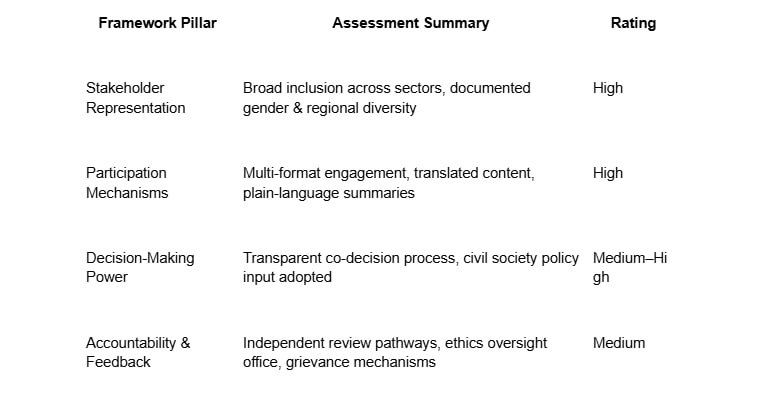
Process architecture matters.
A structured, well-documented stakeholder process yields more trust and higher-quality policy.
Language and format shape inclusion.
Kenya’s use of translations, infographics, and non-text media opened the doors to non-technical stakeholders.
Civil society must have decision-making power, not just a seat.
Tokenism is avoided when input is linked to outcome—Kenya did this better than most LMICs.
Sustainability requires institutionalization.
One-off consultations fade without embedded oversight bodies. Kenya’s AI Ethics Office offers a model.
Kenya’s model offers key takeaways for global governance bodies:
Inclusivity requires upfront design and resourcing.
Translation, engagement tools, and platform design are not add-ons—they’re fundamentals.
Academic–civic coalitions can drive evidence-based AI policy in low-resource environments.
Global policy bodies (like GPAI and UNESCO) can replicate Kenya’s model to engage underrepresented regions through localized forums, taskforces, and citizen labs.
Digital grievance platforms are essential, especially where trust in government is low.
This framework was developed to diagnose and improve inclusion in global AI governance. Built on qualitative analysis from the Nigeria and Kenya case studies, it captures structural and procedural dimensions that influence meaningful representation in policy-making processes.
The Inclusivity Assessment Framework comprises four core pillars, each with measurable indicators:
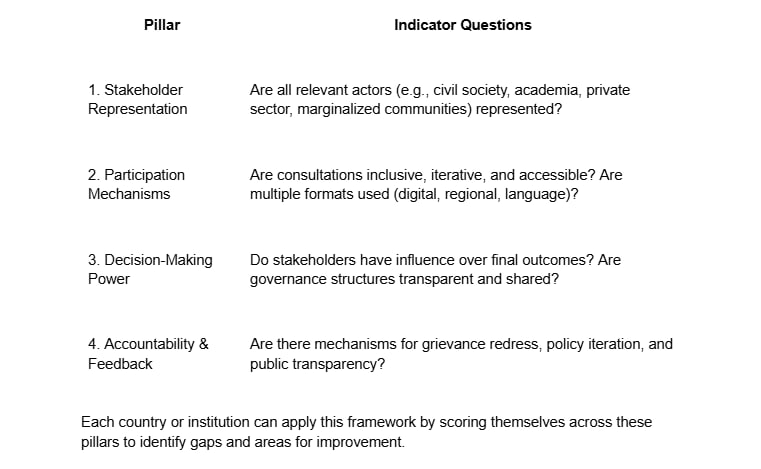
To be useful globally, the framework must be both scalable and adaptable. It is designed to be used by:
Multilateral institutions (e.g., UN, GPAI, OECD)
Regional blocs (e.g., AU, ASEAN)
National governments or taskforces
Civil society coalitions or policy labs
It supports self-assessment, peer review, or independent evaluation, allowing governance stakeholders to benchmark themselves across inclusive metrics.
Drawing from both case studies and broader policy analysis, the following global governance gaps emerge:
Overcentralization in elite institutions like OECD and GPAI, where emerging economies often have observer, not decision-maker, status.
Funding asymmetries that bias global consultations toward large organizations or well-resourced states.
Short timelines for policy feedback limit LMIC participation.
English-language dominance excludes a vast population from understanding or contributing.
Limited participation formats—often only formal policy papers or digital forms, not community-based consultations.
Epistemic injustice: Technical expertise is privileged over local knowledge or lived experience.
Undervaluing informal governance—such as civil society dialogue forums, youth coalitions, or religious institutions involved in advocacy.
Create Inclusive Taskforces with geographic representation quotas and rotating leadership.
Translate Drafts of global AI frameworks into regional languages and use audio-visual formats.
Fund Participatory Infrastructure (e.g., digital public platforms, AI citizen juries, LMIC-based ethics hubs).
Institutionalize Inclusion through permanent multi-stakeholder councils with civil society seats.
Adopt Frameworks for Self-Audit of national AI policies based on this Inclusivity Assessment.
Invest in Policy Literacy by funding public education programs and convenings.
Document & Share exclusionary experiences to inform future consultation reforms.
Leverage Collective Advocacy (as seen with KICTANet, BudgIT) to claim space in policymaking.
Develop Local Scorecards to assess and report on inclusivity in national and regional AI governance.
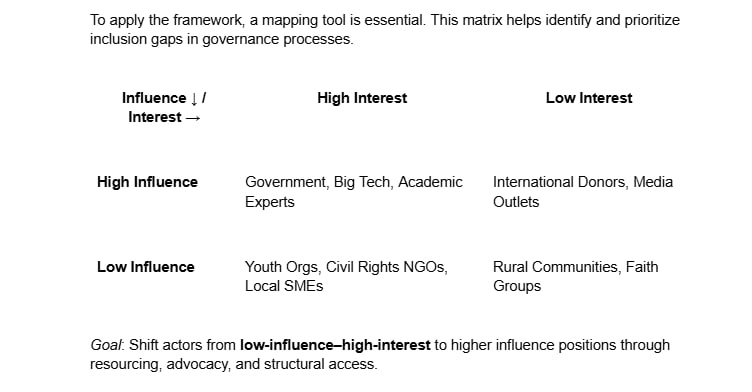
For sustainable impact, this framework should not be a one-off. It must be embedded into policy cycles:
Baseline Assessment – Before strategy is designed
Mid-Cycle Review – During policy drafting
Post-Implementation Review – 12–24 months post-release
Public Scorecards – To communicate progress or regress
Proposal: A globally coordinated Inclusive AI Governance Index could offer benchmarking for countries and institutions.
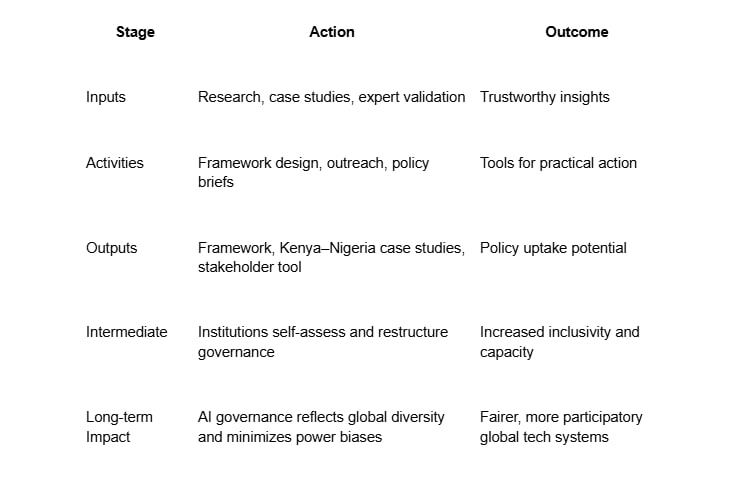
AI will define the distribution of power, opportunity, and dignity in the 21st century. If governance of AI is to be just, it must be inclusive by design. This research, rooted in the real-world challenges and innovations of Nigeria and Kenya, proposes a path forward—one that others can adapt and extend.
Inclusive AI governance is not charity—it is clarity. It is a strategy. It is how we ensure that technologies of tomorrow emerge from, and serve, the needs of all humanity.
The Kenya and Nigeria case studies, when viewed together, offer critical insights into how governance cultures, institutional maturity, and civil society vibrancy impact inclusivity. Though both countries are actively pursuing AI-related policy development, they exhibit different models of engagement:
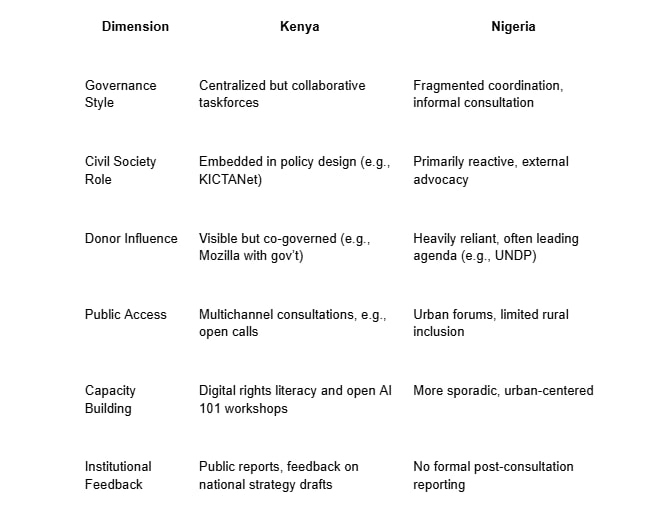
Kenya demonstrates that meaningful multistakeholder governance is possible in an emerging economy context—but it requires structured incentives, institutional will, and trusted civil actors. Nigeria highlights the dangers of elite capture and ad hoc participation, where inclusion is symbolic rather than structural.
This section integrates recent findings from academic, grey, and policy literature to ground this research within broader AI governance discourse.
The literature is rich on the power asymmetries in international norm-setting, particularly in AI ethics and safety. Most governance recommendations originate in Western institutions (e.g., EU AI Act, U.S. Executive Orders, OECD AI Principles). The lack of LMIC participation risks embedding a form of "digital coloniality", where AI is governed without consent of those governed.
Key Source: Dignum et al. (2023), "AI Governance and Global Equity", AI & Society
"Norm diffusion in AI policy is unidirectional, privileging epistemologies of the North."
New approaches argue for citizen juries, participatory foresight, and deliberative assemblies as counterweights to technocratic rule.
Brazil’s Internet Governance Forum (IGF) model is frequently cited as a success for multi-sector inclusion.
India’s Digital India program used village-level consultations during internet rollout (less so in AI).
Key Source: Eubanks (2020), "Automating Inequality"
"Participation without power is theater, not governance."
AU’s AI Strategy (2023) is Africa’s most ambitious attempt at regional AI alignment. However, critics note limited public review opportunities and a heavy reliance on foreign consultants.
ASEAN has developed voluntary AI principles that reflect member diversity—but lacks enforcement power.
Key Source: GPAI Working Group on Responsible AI (2024), “Inclusivity in Governance: Toward a Global North–South Compact”
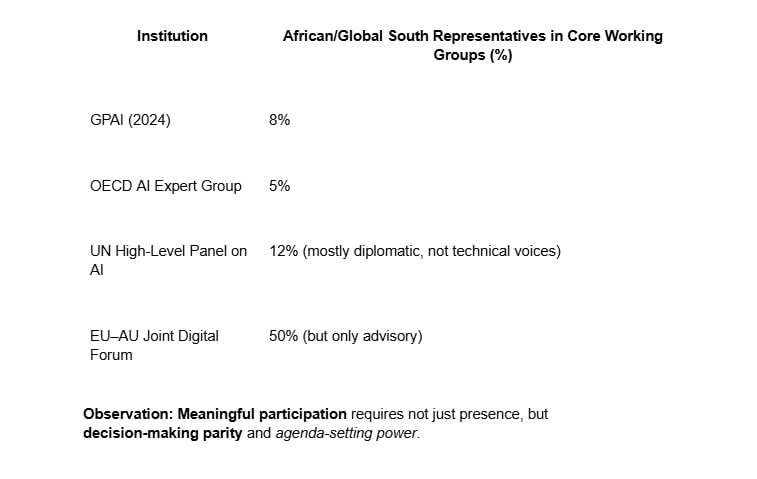
Quantifying representation is difficult due to the opacity of many governance processes.
However, proxy indicators reveal stark underrepresentation.
┌──────────────────────────────────────┐
│ Elite Decision-Makers │
│ (Tech firms, G7 states, UN panels) │
└──────────────▲───────────────────────┘
│
┌──────────────┴──────────────┐
│ Limited Participation │
│ (Token experts, donors) │
└──────────────▲──────────────┘
│
┌──────────────┴──────────────┐
│ Civil Society from LMICs │
│ (Reactive, underfunded) │
└──────────────▲──────────────┘
│
┌──────────────┴──────────────┐
│ Local Communities │
│ (No voice, affected most) │
└─────────────────────────────┘
Goal: Restructure toward a shared governance model, where those most affected have institutional seats, not symbolic roles.
Case Insights Across Emerging Economies (Snapshots)
Released a national AI strategy (NITI Aayog, 2020).
Public consultations were limited but covered large language diversity.
Civil society critiques led to withdrawal of surveillance-heavy AI project proposals.
Participatory roots in Internet Governance extend to digital policy.
Maintains public consultation platforms with mandatory feedback mechanisms.
Used citizen juries in ethical deliberation for AI surveillance in urban policing.
AI Strategy launched in 2022.
Limited civil participation, but strong private-sector collaboration with Tokopedia, GoJek, and BRI.
Absence of public grievance mechanisms raised in Parliament AI oversight hearings.
Inclusivity isn’t just a moral imperative—it affects technical safety.
Non-inclusive AI design leads to brittle systems—unsafe when deployed in unforeseen environments.
Biases and harms emerge faster in marginalized communities with fewer redress options.
Governance blind spots mean risks (e.g., disinformation, surveillance, economic displacement) go unmonitored in LMICs.
"Inclusive governance is a core layer of AI safety—not a parallel concern."
— C. Cath, Alan Turing Institute
The status quo assumes a trickle-down model of AI ethics, where principles made in Washington, Brussels, or Tokyo will naturally extend to Nairobi or Lagos. This assumption fails for three reasons:
Context mismatch: Socio-legal systems differ dramatically.
Power imbalance: LMICs can’t enforce their own standards internationally.
Feedback vacuum: Top-down frameworks often ignore post-deployment consequences in low-data environments.
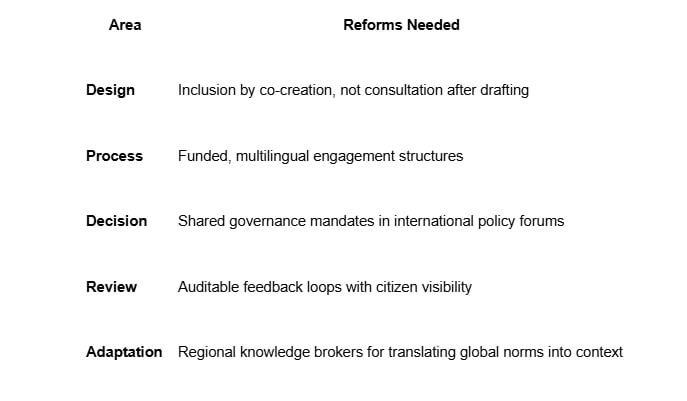
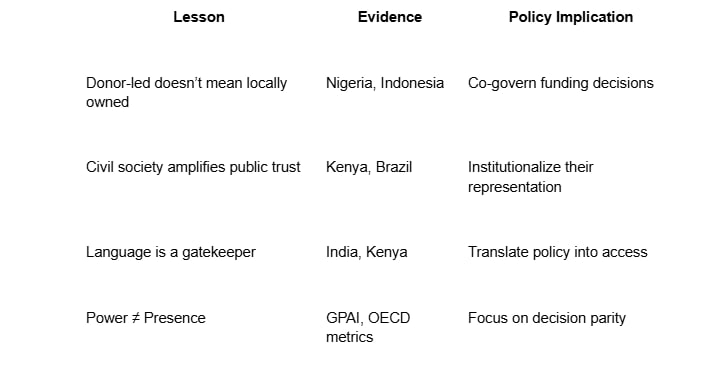
To convert this research into a usable policy instrument, this project proposes a modular framework designed for adoption by multilateral bodies, regional blocs, and national AI strategy teams.
Stakeholder Matrix
Power-interest grid to map current actors
Special flagging for excluded groups
Adaptable to regions or sectors
Participation Heatmap
Captures mechanism frequency and accessibility
Score indicators: transparency, multilingualism, continuity
Decision Audit Tracker
Logs who sets agendas, who edits, who approves
Highlights donor vs. public ownership in drafts
Accountability Flowchart
Maps complaint, review, and redress channels
Flags bottlenecks or absence of citizen interface
┌────────────────────┐
│ Stakeholder Matrix │
└────────▲───────────┘
│
┌────────┴────────┐
│ Participation │
│ Heatmap │
└────────▲────────┘
│
┌────────┴────────┐
│ Decision Audit │
│ Tracker │
└────────▲────────┘
│
┌────────┴────────┐
│ Accountability │
│ Flowchart │
└─────────────────┘
Each layer informs the next, allowing policy teams to score, revise, and report on inclusivity.
To convert insights into actionable reforms, below is a tailored roadmap by stakeholder category.
Multilateral Institutions (UN, GPAI, OECD)
Mandate shared governance structures in technical working groups (e.g., 50% LMIC representation in AI sub-panels).
Establish an Inclusivity Office to monitor participation across all digital policy work.
Require funded member states to submit annual inclusivity scorecards.
Build a Global South Consultation Fund to enable small CSOs and regional actors to attend deliberations.
National Governments (especially LMICs)
Institutionalize open consultation cycles with published response matrices.
Adopt the Inclusivity Assessment Framework for drafting digital strategies.
Translate digital policy drafts into major local languages before finalization.
Engage diaspora AI communities for global-to-local knowledge transfer.
Regional Blocs (AU, ASEAN, Mercosur)
Align national AI strategies to regional inclusion benchmarks.
Host joint policy hackathons that prototype inclusion tools (e.g., citizen dashboards).
Convene rotating public panels to co-create ethical norms rooted in local realities.
Establish a Digital Policy Observatory that tracks AI policy implementation across member states.
Donors and Philanthropic Actors
Fund co-design processes, not just consultancies.
Require local CSO partnership for all AI governance pilot grants.
Support the open-source development of inclusion metrics.
Sponsor regional training in policy literacy, civic tech, and AI auditing.
Civil Society and Academia
Build national databases of digital harms and exclusion incidents.
Train AI policy fellows from underserved regions to act as liaisons with state actors.
Create open-access research libraries translated into local contexts.
Leverage digital tools (e.g., WhatsApp surveys, community radios) to collect grassroots voices.
If global AI governance becomes more inclusive through structured tools, better representation, and transparent decision-making, then AI deployment will reflect diverse global values and be safer, fairer, and more socially aligned.
Inclusion = early-stage power, not downstream adjustment
Representation = decision-making weight, not attendance
Tools = actionable, repeatable, and visual
This research affirms that inclusive AI governance is both necessary and possible. As emerging economies continue to adopt and shape AI, their absence from global norm-setting risks entrenched harm and systemic unfairness.
By designing a framework, mapping real-world models, and offering policy-ready tools, this project contributes to a growing movement for fairer digital futures—one in which equity, not efficiency, drives governance.
As AI becomes more foundational to global progress, so too must our efforts to govern it with empathy, balance, and bold inclusivity.
The work does not end here. This framework will evolve through feedback, regional piloting, and continued collaboration. It is a contribution to something larger: a world where no region is invisible, and no future is built without consent.
References
Dignum, V., Cowls, J., & Taddeo, M. (2023). AI Governance and Global Equity. AI & Society.
Eubanks, V. (2020). Automating Inequality. St. Martin’s Press.
GPAI (2024). Inclusivity in Governance: Toward a Global North–South Compact.
OECD (2022). AI Policy Observatory. https://www.oecd.ai
UNESCO (2021). Recommendation on the Ethics of Artificial Intelligence.
UNDP Nigeria (2023). AI Strategy Consultation Briefs.
Vilsquare.org (2024). Community-Language AI Programs. https://vilsquare.org
BudgIT (2024). OpenGov Toolkit for AI Monitoring.
80000 Hours Problem Profile on AI Governance. https://80000hours.org
Non-Trivial Research Program Guide Docs (2025). [Internal use]
Cath, C. (2024). “AI Governance as AI Safety.” Turing Institute Working Paper.